

Eventi, Notizie, Pubblicazioni
The CERN Council decided to update the European Strategy for Particle Physics
Budapest, 22 May 2026. Today, following more than two years of intense work of the European particle physics community under the auspices of the European Strategy Group, the CERN Council updated the European Strategy for Particle Physics which sets out an ambitious scientific vision for the field.
Immagine: denisismagilov, stock.adobe.com
Florencia Canelli appointed CMS Deputy Spokesperson
Florencia Canelli, Professor of Physics at the University of Zurich, has been appointed Deputy Spokesperson of the CMS Collaboration for the period 2026–2028. In this role, she will support the newly elected Spokesperson Anadi Canepa in coordinating the scientific activities of one of the world’s largest particle physics collaborations, which brings together more than 6000 scientists, engineers and students. Florencia Canelli joined CMS in 2012 and has since held several leadership positions within the experiment. Her appointment highlights the important role played by Swiss institutions in the Compact Muon Solenoid experiment at CERN.
Immagine: CERN
Transition in SHiP Physics Coordination
After twelve years guiding the physics programme of the SHiP Collaboration, Nicola Serra (University of Zurich) is stepping down as Physics Coordinator. Following the recent collaboration election, Lesya Shchutska (EPFL) will take over the role. With this transition, the coordination of SHiP remains in Switzerland, highlighting once again the strong contribution of Swiss institutions to the experiment.
Immagine: CERN, SHiP
Boiling the vacuum
A group of scientists has set out to shed light on an unexplored area of physics using a high-energy electron beam, a laser, a vacuum chamber and a set of detectors. Federico Meloni, scientist at Germany’s national accelerator lab DESY and since December professor at the University of Bern, explains what the “LUXE” experiment is all about.
Immagine: CHIPP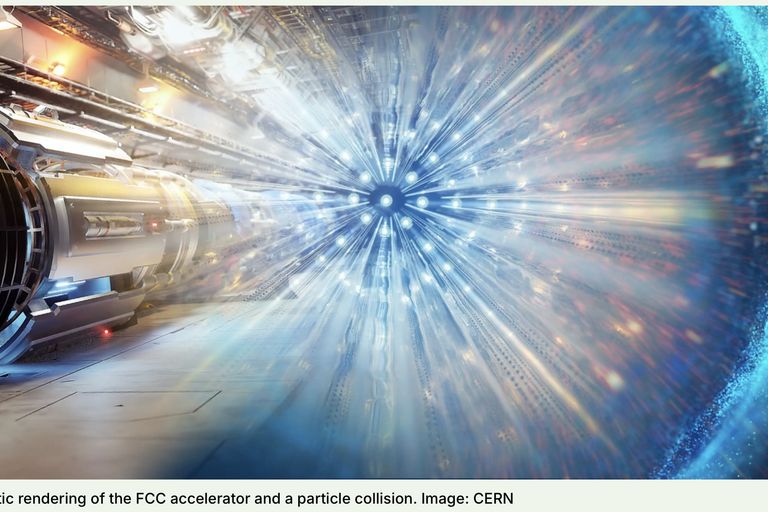
How Switzerland is preparing for the future of particle physics
The European Strategy for Particle Physics is intended to shape the future of particle physics. Under this strategy, the favoured option for the next major project at CERN is the Future Circular Collider. Switzerland seeks to consolidate its expertise in particle physics through targeted support instruments for technology, research and early-career researchers.
Immagine: CERN
Under the Alps: Assessing the Potential of Bedretto for Particle and Astroparticle Physics
ETH visits to the Bedretto Underground Laboratory
Immagine: Google map
The boundary between physics, mathematics and AI is becoming increasingly productive
Physicist and mathematician receive BRIDGE Discovery Grant to optimise supply chains with AI
Immagine: KI-generiert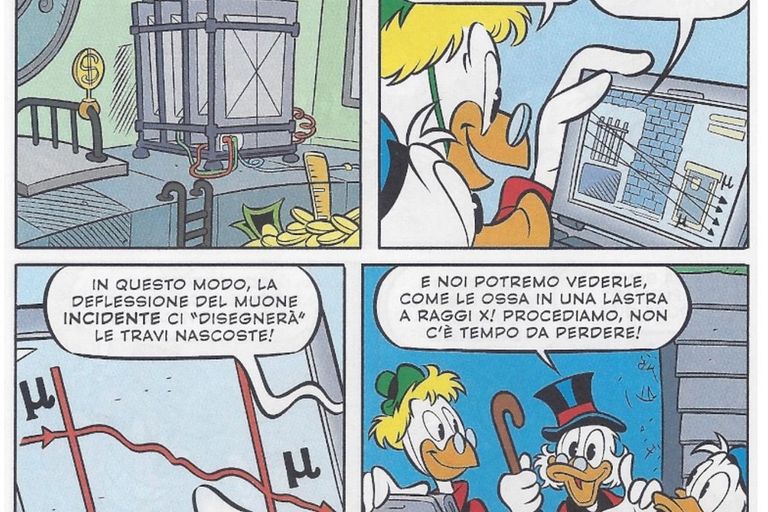
Uncle Scrooge discovers particle physics
Sometimes it takes a simple idea to get science concepts into children’s minds. When the world was in lockdown and parents everywhere juggled home schooling their kids, getting their own work done and keeping everybody happy and healthy, scientist Luigi Marchese thought back to his own childhood and had an idea. Why not combine what he loved as a child – reading comic books, especially the Italian “Topolino” magazine featuring Mickey Mouse, Donald Duck and co – and what he does as an adult – doing particle physics at the CMS detector – to keep kids edutained?
Immagine: Disney
Behind the Scenes of the Large Hadron Collider Upgrade
The Large Hadron Collider, or LHC, is a huge accelerator used by several detector collaborations with over 10,000 scientists to advance our understanding of fundamental physics. While we often cover news like the measurement of new particles or the precise determination of fundamental constants, today we would like to focus on the less visible work needed for the LHC detectors to function. We are speaking with Dr. Silke Möbius, a postdoctoral researcher, and Camilla Tognina, an electrical engineer, who are developing a read-out system for the new inner detector (Inner Tracker) of the ATLAS experiment. This project started in 2018 in the group of Professor Michele Weber at the University of Bern and involved in total 37 people at the various stages of the project.
Immagine: CHIPP